What Nobody Tells You About Psychological Safety in High Performing Teams…
Get Comfortable With Being Uncomfortable
Are you sitting comfortably? Maybe with a cushion, a warm coffee, fluffy slippers…
Humans are drawn to comfort. It feels lovely. And who doesn’t want to feel good? Well, actually… high-performing teams often don’t feel good. In fact, high performing teams are often uncomfortable.
There are misconceptions about psychological safety with people thinking that it means either, a) it’s all sparkle and rainbows and being nice to each other and being pals, or b) it creates environments that lets people say whatever they want, complain all the time and excuse bad behaviour.
A culture with psychological safety means neither of these things. Psychological safety is a key foundation for growth – and growing means stretching and changing which can be uncomfortable. It does not mean no disagreement, no challenge or no accountability. It creates conditions for peak performance as people can openly learn from mistakes, have rupture and repair and try again.
In Amy Edmondson's research, the leading voice in this field of work culture, she discovered that high-performing medical teams were those who reported the most errors. By sharing their mistakes in high stakes environments, like heart surgery, teams could learn quickly from each other and adapt. Yet, in other high-pressure environments – like law, accounting and finance, there often are junior staff not questioning anything, senior staff not admitting that they are at capacity and teams defaulting to ‘we’re fine’. On paper: performance looks strong.
Underneath that silence there is risk. Errors are more likely and the silence does not correlate to professionalism – it’s data reflecting something dangerous.
Compliance vs Real Safety
Many organisations are compliant with their mental health policies and inclusion statements. And many good professionals are compliant too. They are used to being well-behaved, top of the class, a ‘model student’.
I was one of those students too.
I thought greatness meant getting all the ‘right’ answers and following the rules. Every report card I had in school remarked on how conscientious I am. Then, life happened and things didn’t really go ‘to plan’. I ended up dropping out of school and university, having a squiggly career and achieving milestones at different times to my peers. Now I realise that greatness is not about getting it ‘right first time’ – it’s about a commitment to trying again and learning from what is not working.
By training as a therapist and working in childcare, I realised that good parents actually can have naughty children. If a child is safe enough to show you their ‘bad’ emotions and act out then it means that they are safe enough to express themselves. As a grown-up, I’d much prefer to regulate and guide that child through a tough time than let them struggle in silence and internalise this ‘badness’. It’s the quiet children that you worry about.
The same goes for compliant organisations. Well-behaved staff do not ask the hard questions or share about their mistakes. There is no opportunity to learn and grow together.
However, I’m not saying break all the organisational policies and do whatever you want. (That stresses me out too). You can be professional and a great employee and still be curious, ask challenging questions and admit when you are wrong. In my own journey I have found that people actually respect me more when I admit that I have not shown up in the way that I wanted, and I try again. What stops us from doing that is often our ego. It does not feel good to let people see our ‘not shiny’ parts. But it makes us human and relatable and role-models how others can show up.
What Psychological Safety Actually Requires
No one comes up with a good idea when being chased by a tiger, right?
Safety is required for anyone to be innovative or creative. If we are in fight or flight, crisis mode and running on adrenalin, we physically prioritise survival, not curiosity. This is similarly true in the jungle as in the office. A stressed office is not a safe office. Our nervous systems communicate with each other and without a regulated ‘home base’ to return to, we cannot adventure and try new things. This is as equally true for children playing as adults in professional roles.
To create that safety, again for children or adults, we need boundaries and clarity. We need to agree on ‘This is what we do here’ and role model that. We need leaders that notice patterns, name concerns and escalate for support. We need managers that show empathy and legal responsibility, but do not stray into therapy territory.
Practical Scripts
Theory is great, but what does that look and sound like? Here are a couple of example scripts that you could use to start cultivating psychological safety:
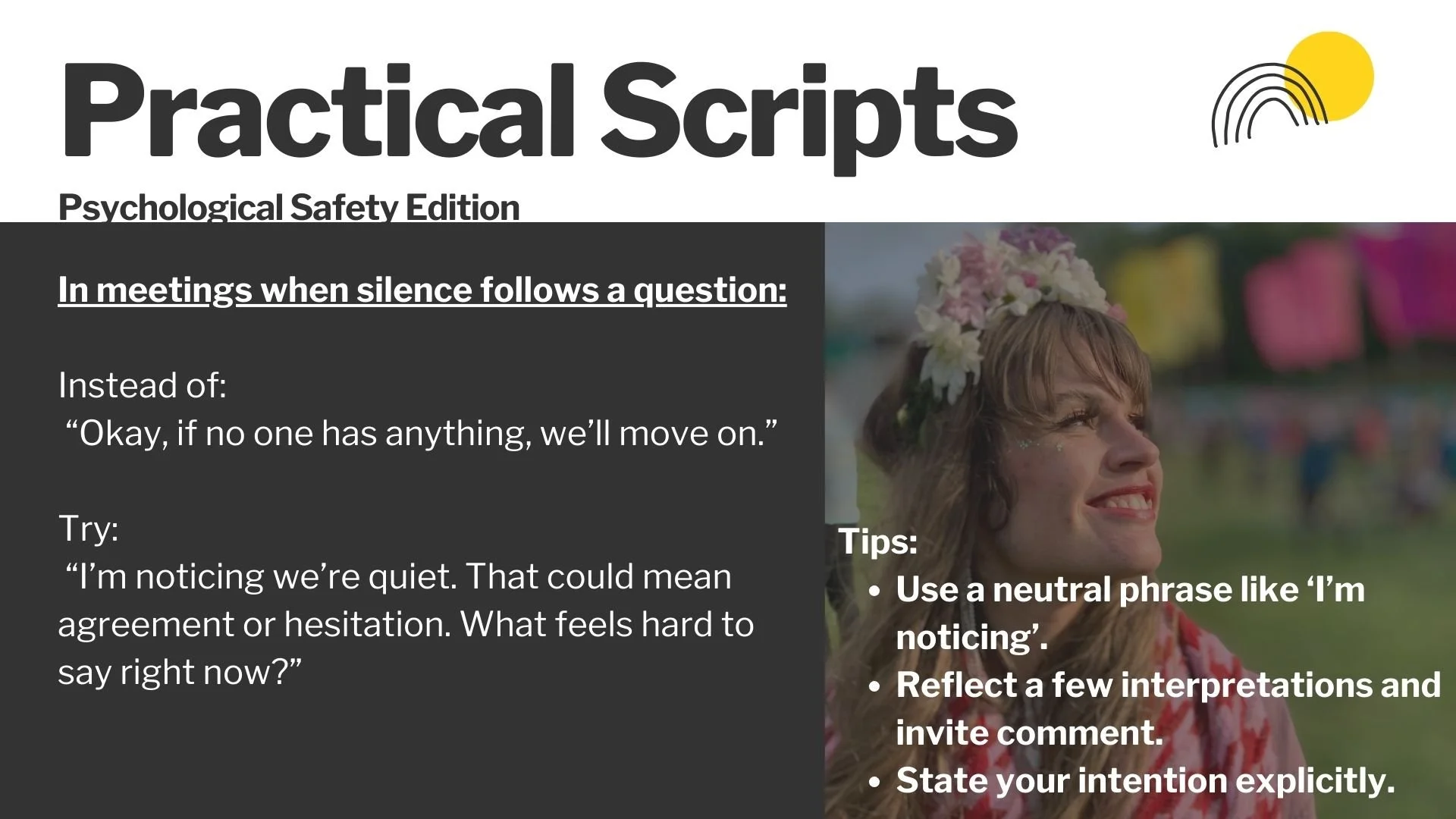
In meetings when silence follows a question:
Instead of: “Okay, if no one has anything, we’ll move on.”
Try: “I’m noticing we’re quiet. That could mean agreement or hesitation. What feels hard to say right now?”
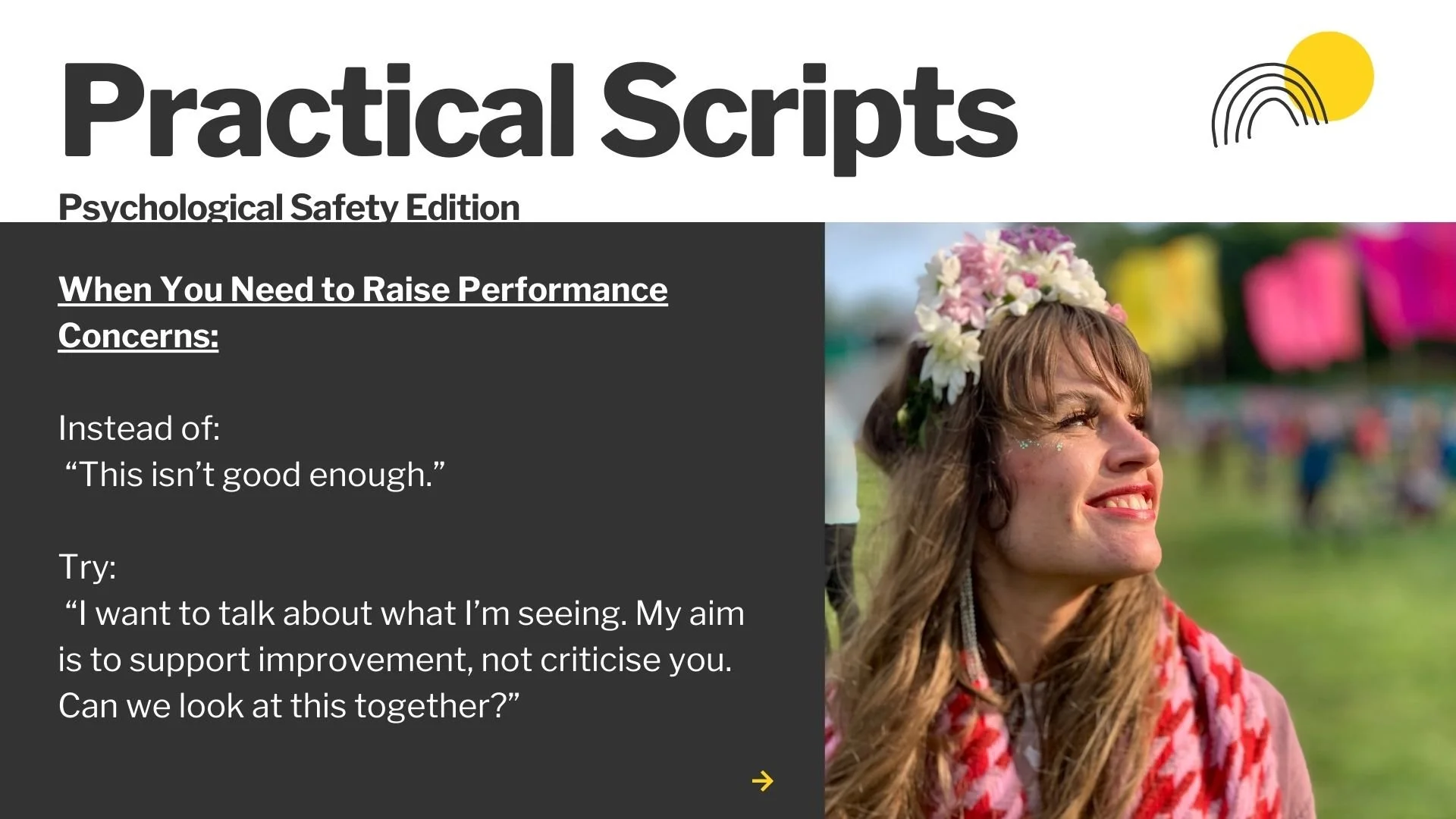
When you need to raise performance concerns:
Instead of: “This isn’t good enough.”
Try: “I want to talk about what I’m seeing. My aim is to support improvement, not criticise you. Can we look at this together?”
Both of there are direct and calm. There is a neutral noticing of the situation and a curiosity of spirit.
In order to cultivate a culture of safety, we need to teach the skills of boundaries, active listening, assertiveness and empathy. Great organisations empower people to prioritise courage over comfort. Today I hope you feel brave enough to ask yourself -where does silence show up in our organisation? And what conversations are we delaying?
Psychological safety isn’t comfort - it’s courageous leadership supported by structure.
If your managers need more than awareness - if they need clarity, boundaries and real conversational tools - I’d be happy to explore how I can support.